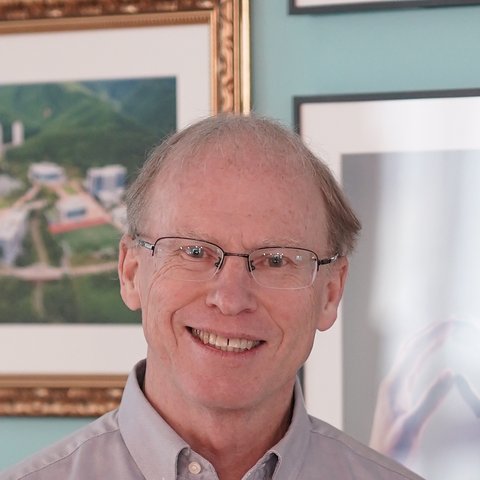
Rodney S. Ruoff
Distinguished Professor, UNIST
Director, IBS Center for Multidimensional Carbon Materials (CMCM)
Distinguished Professor, UNIST
Director, IBS Center for Multidimensional Carbon Materials (CMCM)
Rodney S. Ruoff received a B.S. in Chemistry (High Honors) from the University of Texas at Austin (1981) and a Ph.D. in Chemical Physics from the University of Illinois at Urbana (1988). He was a Fulbright Fellow at the Max Planck Institut für Strömungsforschung in Göttingen, Germany (1988–90), and then a postdoctoral researcher at the IBM T.J. Watson Research Center.
His academic career has included appointments as Research Scientist at SRI International, Associate Professor of Physics at Washington University in St. Louis, John Evans Professor of Nanoengineering at Northwestern University, and the Cockrell Family Regents Chair in Mechanical Engineering at the University of Texas at Austin (2007–2013).
Since 2013 he has been a UNIST Distinguished Professor and the founding Director of the IBS Center for Multidimensional Carbon Materials in Ulsan, Republic of Korea. His research concerns the design, synthesis and study of new forms of carbon and related materials with exceptional physical and electronic properties.
Accelerated Basic Science, AI/machine learning/robotics with materials and chemistry, carbon and boron nitride materials (fullerenes, CNTs, graphenes, diamond, porous carbons, others; and their BN and CBN analogs and variants); and liquid metal fluxes with dissolved first-row elements (particularly C, B, and N)
AI/machine learning/robotics with materials and chemistry.
Fullerenes, CNTs, graphenes, diamond, porous carbons, and others.
The BN and CBN analogs and variants of these carbon materials.
Liquid metal fluxes with dissolved first-row elements, particularly C, B, and N.
The work begins in the 1980s with laser and microwave spectroscopy of small molecules and weakly bound clusters. In the early 1990s, how fullerenes dissolve, and the nested carbon shells that form around metal-carbide crystals. Also in the early 1990s, how van der Waals attraction between adjacent multiwalled nanotubes flattens them along their contact, seen in the electron microscope, and how the same attraction makes single-walled nanotubes flatten against one another into a faceted packing in a nanotube crystal. From 1999, what a single carbon nanotube carries before it breaks, and how its nested shells slide within it, measured one tube at a time inside an electron microscope. Also from 1999, the tailoring of graphite into micrometre islands with the goal of obtaining single sheets. From 2003, how nanotubes and graphene behave in composites and films. In the 2000s, graphite oxide and its reduction, dispersions filtered into freestanding paper, and the growth of graphene on copper by chemical vapour deposition. In the 2010s, single-crystal metal foils and single-crystal graphene grown on them, boron nitride films and nanotubes, carbon electrodes for supercapacitors and batteries, and carbons that catalyse reactions without a metal. Most recently, diamane, diamond–metal interfaces, carbon in liquid metals, unseeded growth of diamond at one atmosphere pressure in a metal flux, and the mechanics of macroscopic single-crystal graphene.
Ulsan, Republic of Korea
University of Texas at Austin
Northwestern University
Washington University in St. Louis
SRI International
IBM T.J. Watson Research Center
Max Planck Institut für Strömungsforschung, Göttingen
University of Illinois at Urbana
University of Texas at Austin